Voice of AI: AI is getting faster. Money is becoming more cautious.

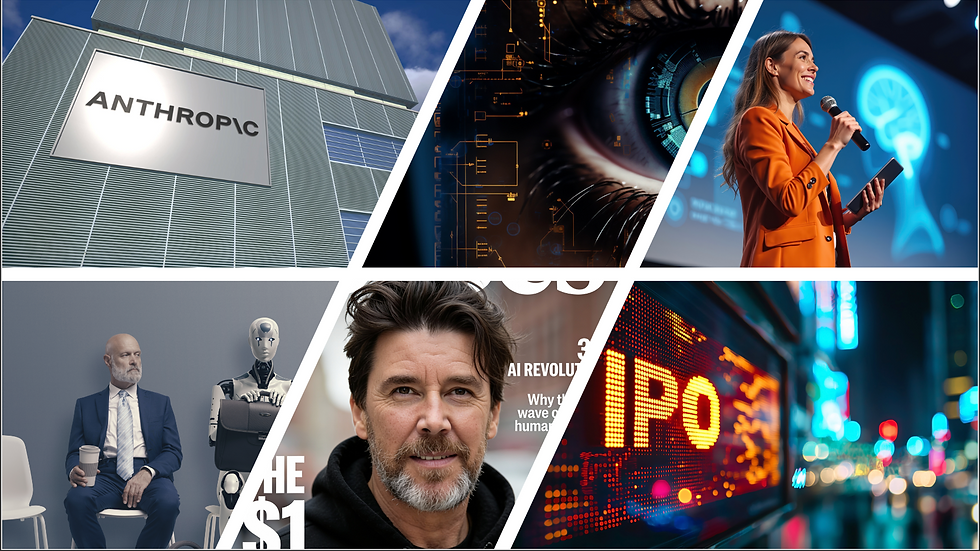
On Thursday, an AI agent in a Visa test purchased a television that didn't meet the customer's specifications. That same day, the Nasdaq fell 5.5 percent. And two days earlier, Anthropic had notified the U.S. Securities and Exchange Commission in writing that AI could soon dramatically accelerate its own research. Three news stories, one pattern: Capabilities are growing faster than trust. Do you know which side of this equation your company is on?
When AI works on AI
In its revised prospectus, Anthropic did something no other frontier lab has done before regulators: the company stated it may be close to the threshold at which AI accelerates AI research itself. Crucially, no current model was rated as being above this threshold. The external review followed promptly. METR estimates that Anthropic's capability growth on clearly defined tasks in October 2026 was roughly twice as fast as between March 2024 and October 2025. The downside: the majority of the most compelling evidence was redacted in the public version.
What this means for you: Your AI providers' roadmaps are no longer constant. Anyone who bases their architecture on a single model is building on sand. This is precisely where our AI Readiness Check comes in: It shows how adaptable your organization is when technology changes faster than your planning cycles.
The market is calculating
The S&P 500 fell 4.4 percent on November 5, its biggest drop since April 2025. Nvidia dropped 8.91 percent, and several suppliers lost more than 16 percent. Lab valuations followed suit. Investors now consider the $1.5 trillion valuation discussed for Anthropic to be the upper end of expectations. OpenAI raised $11 billion at $1.25 trillion, below its initial $1.4 trillion target.
This isn't a crisis, but rather a correction in pricing expectations. For every acquisition, every investment, and every major contract, the rule now is: technology must be evaluated before it's paid for. With ARGUS Technology Due Diligence , we examine what's really behind the promises.
Computing power has an expiration date.
Microsoft is letting its lease agreement with Oracle expire because the servers were using older Nvidia chips that no longer met requirements. The consequence for every CFO: Anyone buying or leasing GPU capacity today should expect depreciation cycles more reminiscent of smartphones than machinery.
Agents with a buy button, but no judgment
Visa has conducted its first systematic test of AI-powered purchasing agents. The models failed in 42.8 percent of the runs. In 54 percent of the failed attempts, purchases were still made. Translated into everyday business terms: An agent that triggers orders, commissions suppliers, or approves invoices needs clear approval limits. Autonomy without a control point doesn't lead to increased efficiency, but rather to liability risks.
Goldman draws the line
Goldman Sachs is restricting Claude Code and GitHub to its engineers, denying access to traders and bankers. This isn't a retreat from AI, but rather a governance issue. The question isn't "AI yes or no," but "which AI for whom." To answer this, one must know what competencies are actually present within the team. Our AI Competency Assessment provides the necessary data foundation.
Germany sets measurable goals
At the Digital Summit, the German government presented concrete figures for the first time. By 2030, at least 55 percent of SMEs are to use AI, and data center capacity is to quadruple. This is ambitious. However, progress will not be measured by strategy papers, but by productive applications. For SMEs, the path to achieving this begins with an honest assessment of their current situation.
📌 Key takeaways of the week
AI is measurably accelerating AI research, but the evidence is largely redacted. Vendor roadmaps are becoming more volatile.
The capital market is reassessing AI: Trillions in losses in one day and falling valuations for Anthropic and OpenAI.
GPU capacity is becoming obsolete faster than expected; Microsoft is ending lease agreements for older chips.
AI agents fail in 42.8% of shopping tests, yet often still make purchases. Approval limits are mandatory.
Germany aims to get 55% of SMEs using AI by 2030. The starting point is an honest analysis.
Sources
Anthropic Says Recursive Self-Improvement May Be Imminent, ShiftDelete.net , November 3, 2026, https://shiftdelete.net/en/anthropic-recursive-self-improvement
Anthropic AI R&D Acceleration Assessment, METR, November 5, 2026, https://metr.org/blog/2026-11-05-anthropic-ai-rd-acceleration-assessment/
A brutal sell-off for AI stocks sends Wall Street reeling, Associated Press, November 5, 2026, https://www.wsmv.com/2026/11/05/brutal-sell-off-ai-stocks-sends-wall-street-reeling-sp-500-sees-worst-day-since-2025-liberation-day-tariffs/
AI backlash could threaten Anthropic IPO timing, Reuters, November 5, 2026, https://www.ctvnews.ca/business/article/ai-backlash-could-threaten-anthropic-ipo-timing-potential-investors-say-reuters-exclusive/
OpenAI reportedly raises an additional $11 billion, TechCrunch, November 6, 2026, https://techcrunch.com/2026/11/06/openai-reportedly-raises-an-additional-11-billion-at-a-1-25-trillion-valuation/
Microsoft is winding down its deal to rent AI computing from Oracle, The Next Web, November 6th, 2026, https://thenextweb.com/news/microsoft-winds-down-oracle-ai-cloud-capacity-deal
Visa Agentic Commerce Benchmark, Visa, November 5, 2026, https://usa.visa.com/about-visa/newsroom/press-releases.releaseId.22936.html
Goldman Restricts Traders and Bankers From Using Some AI Tools, Bloomberg, November 2, 2026, https://www.bloomberg.com/news/articles/2026-11-02/goldman-restricts-traders-and-bankers-from-using-some-ai-tools
Press conference at the Digital Summit 2026, Federal Government, November 2, 2026, https://www.bundesregierung.de/breg-de/aktuelles/digital-gipfel-pk-merz-2459634
Conclusion
This week has shown that speed alone is not a business model. Technology is accelerating, but markets, banks, and consumers demand proof, boundaries, and accountability. Winners are not the fastest, but those who know where they stand, what they buy, and to whom they give which tools.
Where does your company stand? Start with the AI Readiness Check at readiness.oakai.de or write to us directly at info@oakai.de .
The future is not a matter of chance. It is a choice. Ralph Schwehr, OAKAI