Voice of AI: 🧠 AI at the tipping point: Regulation, returns & reality tests
- Ralph Schwehr

- Dec 8, 2025
- 5 min read
This week, the AI world feels like a stress test under laboratory conditions . Regulation, capital markets, enterprise adoption, and infrastructure are all intertwined. It is precisely at this intersection that it will be decided who writes the rules of the game in the emerging "ecosystem of intelligence" and who merely follows them.
Enjoy reading, Ralph Schwehr
1. Regulation & Trust: AI in the Legal and Political Stress Test
In the UK, over 100 parliamentarians from various parties are calling for binding rules for the most powerful AI systems, including independent audits, global oversight, and clear liability structures. The appeal is coordinated by Control AI and supported by researchers such as Yoshua Bengio. The message: "Self-regulation" is no longer acceptable as the sole answer to existential risks.
In parallel, the OpenAI vs. New York Times case is shifting the line between product innovation and the obligation to disclose information. The order to hand over 20 million anonymized chat logs creates a potential precedent for future content lawsuits and increases the pressure on AI providers to better document their training and usage data.
For companies, this means:
“Black box” arguments are losing their persuasive power; internal documentation and auditability are becoming a competitive factor .
AI governance is moving from the legal department to the board of directors .
Those who invest in transparency today reduce litigation and reputational risks tomorrow.
2. Return & Risk: When pension funds hedge the AI trade
Experts know that tech crashes hurt, but when conservative pension funds start cutting their US tech allocations, it's a signal of a different magnitude. This is precisely what's happening in the UK: funds with a combined total of over £200 billion are shifting money from US tech to domestic and Asian markets or diversifying more into bonds, gold, and private markets.
The triggers are the extreme index concentration on a few AI winners and the fear of an "AI bubble." These portfolio shifts coincide with a period in which markets are simultaneously speculating on a Fed interest rate cut. This cocktail of factors is affecting both tech valuations and commodity prices.
For CFOs, asset owners and corporate finance teams, the question arises:
How much AI exposure do we really want in our balance sheet and pension fund?
How do we protect ourselves from correlations when AI hardware, cloud providers, and growth metrics are all tied to the same story?
What role can "real assets" (infrastructure, raw materials, energy) play in a portfolio when AI investments place massive demands on the physical world?
The message from pension funds: AI yes, but please with evaluation discipline and risk management.

3. Enterprise AI & Agents: Between Hype and Proof of Benefit
Microsoft had proclaimed the "Age of AI Agents," but now internal growth targets for new AI products are being scaled back after many sales teams failed to meet their ambitious quotas.
The reality: Many companies have pilots, POCs and demos, but no scalable agent workflows with clearly measurable business impact.
What's interesting is how Microsoft is reacting: Instead of just launching new interfaces, Satya Nadella wants to make Excel the hub for autonomous agents, thus moving it to the very place where financial models, scenario planning, and operational KPIs have resided for decades. Agent Mode and Office Agent bring multi-agent systems directly into existing workflows.
This results in a clear roadmap for those responsible for AI:
From chat to operation : Away from isolated prompts, towards end-to-end processes (e.g., forecasting, pricing, claims, supply chain).
Data and tool governance : Agents need access – but controlled access. Permissions, policies, and observability must scale accordingly.
Change Management : Agents are "super-macros" for the entire organization. Without training, clear responsibilities, and monitoring, shadow IT emerges on AI steroids.
In short, the market is beginning to differentiate between an "impressive demo" and a "productive agent layer." This is healthy and an opportunity for everyone who truly considers AI in terms of P&L.
4. XR, Mobility & Infrastructure: AI is entering everyday life and networks
On the consumer and developer side, Google is taking the next step:
Gemini in Maps & Android Auto : Route planning, local recommendations, news summaries, and on-the-go assistance. AI becomes your co-pilot on the road and in trip planning.
Android XR Show on December 8 : Google outlines new tools for glasses and headsets, with close integration of Gemini as a context assistant for mixed reality use cases.
This makes it clear: XR + AI is not just a gaming topic, but the next interface layer for work, training and service.
In parallel, the infrastructure is being reorganized: LogicMonitor is acquiring Catchpoint to unify observability, internet performance, and AI-powered forecasting capabilities on a single platform. This is a logical step when latency, availability, and user experience are business-critical for AI workloads. become.
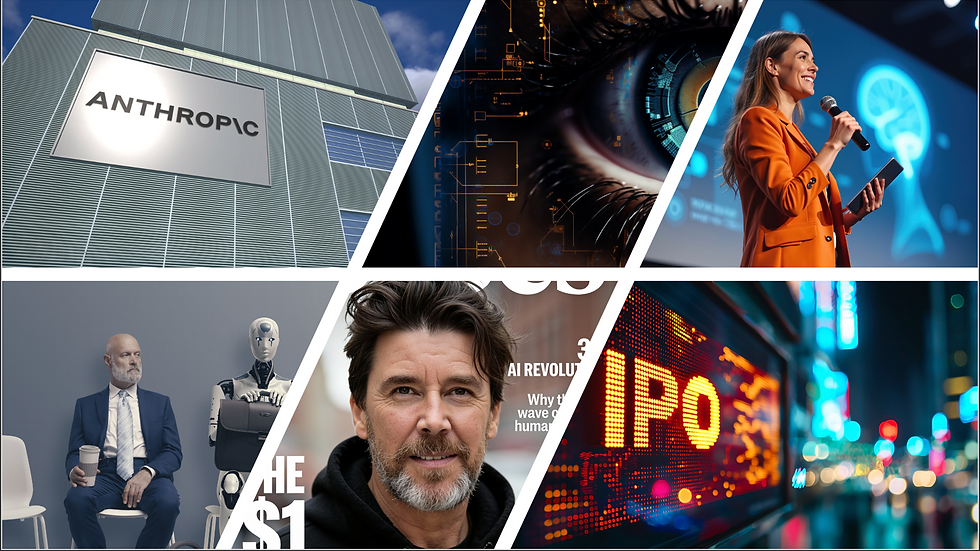
And on the horizon: Anthropic is reportedly pushing ahead with an IPO starting in 2026, possibly one of the biggest AI IPOs ever.
This would not only free up additional billions for computing, research and M&A, but also intensify the comparison with OpenAI in terms of business model, governance and capital structure.

💡 Key takeaways in brief
Regulation is becoming concrete : UK parliamentarians and US courts are increasing the pressure for transparency, auditability and oversight of the most powerful models.
Capital markets are getting nervous : Pension funds are hedging their AI exposure, valuation discipline and diversification are becoming mandatory.
Enterprise AI needs ROI, not just hype : Agents are migrating to Excel & Co., but only clearly defined, measurable use cases will prevail.
AI goes mobile & spatial : Gemini in Maps, Android Auto and Android XR moves AI into the car, to the wrist and in front of the eyes.
Infrastructure and IPOs show the direction : Deals like LogicMonitor × Catchpoint and a possible Anthropic IPO underline that computing power, observability and access to capital are the new power axes.
🔍 List of sources
UK MPs call for tough rules on “most powerful” AI systems : The Guardian, December 8, 2025 https://www.theguardian.com/technology/2025/dec/08/scores-of-uk-parliamentarians-join-call-to-regulate-most-powerful-ai-systems
UK pension funds reduce US tech holdings due to “AI bubble” risk : Financial Times, December 8, 2025 https://www.ft.com/content/1c00d3bd-3f97-420c-8aab-ccce32ccdc37
OpenAI must hand over 20 million ChatGPT logs in copyright case : Reuters, December 3, 2025 https://www.reuters.com/legal/government/openai-loses-fight-keep-chatgpt-logs-secret-copyright-case-2025-12-03/
Microsoft lowers sales targets for new AI products : Ars Technica, December 4, 2025 https://arstechnica.com/ai/2025/12/microsoft-slashes-ai-sales-growth-targets-as-customers-resist-unproven-agents/
Nadella: Excel to become hub for autonomous AI agents : NewsBytes, December 8, 2025 https://www.newsbytesapp.com/news/science/microsoft-excel-could-become-key-platform-for-autonomous-ai-agents/story
Google makes Gemini mobile: new features in Maps & Android Auto : GoogleWatchBlog, December 7, 2025 https://www.googlewatchblog.de/2025/12/google-maps-android-auto-gemini-wird-mobil-bringt-viele-neue-funktionen-fuer-unterwegs-update/
Google “Android XR” Showcase: Updates on Glasses & Headsets : India TV News, December 2, 2025 https://www.indiatvnews.com/technology/news/google-to-unveil-major-android-xr-updates-on-december-8-smart-glasses-and-headsets-teased-2025-12-02-1019926
Report: Anthropic aims for IPO from 2026 : Börsen-Zeitung, December 3, 2025 https://www.boersen-zeitung.de/unternehmen-branchen/bericht-anthropic-koennte-schon-2026-an-die-boerse-gehen
LogicMonitor acquires Catchpoint (Performance Monitoring) : GovCon Wire, December 3, 2025 https://www.govconwire.com/articles/logicmonitor-catchpoint-acquisition-ai
Global: Fed interest rate signal & “AI trade” drive commodities/tech : Reuters, December 8, 2025 https://www.reuters.com/world/china/global-markets-global-markets-2025-12-08/

🎯 Conclusion
This week shows that AI is no longer an isolated technological issue. It determines market value, regulation, infrastructure , and trust . Anyone who wants to be able to act now needs three things simultaneously:
Clarity about one's own AI risk profile (regulation, copyright, data).
A well-founded, yet disciplined investment story (budget, capex, portfolio).
Concrete agent and automation scenarios that already create value today, not just in demos.
👉 Want these insights as a weekly snack? Subscribe to the OAKAI newsletter and also receive a compact deep-dive analysis once a week on topics such as regulation, go-to-market strategies, or the global M&A map in the AI ecosystem.
👉 Want to know what these developments mean for your company? Write to us at info@oakai.de - we'll work with you and your team to develop an AI roadmap, including regulatory requirements, a business case, and infrastructure.
👉 See also https://www.oakai.de/post/in-ki-investieren-ja-in-hoffnung-investieren-nein – a great article by Stefan Böhme!


Comments